

A Quick Start Guide to Reliable Online Psychiatric Evaluations
A Quick Start Guide to Reliable Online Psychiatric Evaluations
Understanding the Spectrum of Online Psychiatric Evaluations
A reliable online psychiatric evaluation is a comprehensive, clinician-led diagnostic assessment conducted via secure video by a licensed psychiatric provider (such as a board-certified psychiatrist or psychiatric nurse practitioner). To obtain one, you schedule an appointment with a licensed psychiatric practice, submit intake documentation and medical history, and participate in a detailed virtual consultation where the clinician evaluates your symptoms, establishes a formal diagnosis, and designs a personalized treatment or medication management plan.
The world of digital mental health is broad. It spans everything from two-minute self-administered quizzes you can take on your phone to rigorous, clinician-led diagnostic interviews. Understanding the differences between these options is essential so you know what kind of information you are getting and what steps to take next.
At KindMind Behavioral Health, we look at digital mental health tools as a spectrum. On one end, you have free, anonymous screening measures designed to provide a rapid snapshot of your emotional landscape. On the other end, you have comprehensive psychiatric evaluations conducted by licensed psychiatric nurse practitioners or board-certified psychiatrists who use diagnostic criteria from the Diagnostic and Statistical Manual of Mental Disorders, Fifth Edition, Text Revision (DSM-5-TR), developed by the American Psychiatric Association, to build an individualized treatment plan.
| Feature | Self-Administered Screening Tools | Clinician-Led Online Psychiatric Evaluations |
|---|---|---|
| Primary Purpose | Triage, symptom awareness, and preliminary screening | Formal diagnosis, differential diagnosis, and treatment planning |
| Administrator | Self-completed by the individual or parent/guardian | Licensed psychiatric provider (MD, DO, PMHNP, PA) |
| Time Required | 2 to 15 minutes | 45 to 90 minutes |
| Diagnostic Validity | Identifies risk or elevated symptoms; cannot diagnose | Meets gold-standard clinical diagnostic criteria |
| Data Evaluated | Specific self-reported symptom checklists | Comprehensive history, mental status exam, psychosocial context, lab review |
| Treatment Outcome | General educational resources and suggestions | Definite diagnosis, psychiatric medication management, and psychotherapy plans |
Preliminary Self-Screening vs. Formal Assessments
Many people begin their mental health journey with self-screening tools. Online screening is one of the quickest and easiest ways to see what mental health symptoms you might be experiencing. It is typically free, quick, confidential, and backed up by science.
For instance, standardized self-report instruments like the Patient Health Questionnaire-9 (PHQ-9) for depression or the Generalized Anxiety Disorder-7 (GAD-7) measure symptom frequency and severity over the past two weeks. Universal digital screeners can assess up to 30 common mental health conditions simultaneously in 10 to 15 minutes, while brief collegiate and community screeners evaluate domains like anxiety, mood changes, eating concerns, frustration, family stress, and alcohol use in just a couple of minutes.
These tools are valuable for identifying distress, but they have distinct limits:
- No Contextual Analysis: A symptom checklist cannot tell whether your fatigue stems from major depressive disorder, thyroid dysfunction, iron deficiency, or chronic stress.
- Lack of Differential Diagnosis: Many mental health conditions share overlapping symptoms. An online quiz cannot reliably differentiate between unipolar depression and bipolar II disorder without a detailed mood and family history.
- No Medical Review: Self-screeners do not evaluate vital signs, concurrent physical illnesses, or dangerous drug interactions.
To understand how a formal assessment moves beyond simple checklists, exploring what a psychiatric evaluation looks like can give you a clear picture of how our psychiatric providers review your developmental history, current stressors, biology, and lifestyle to reach an accurate diagnosis.
Standardized DSM-5-TR Digital Measures
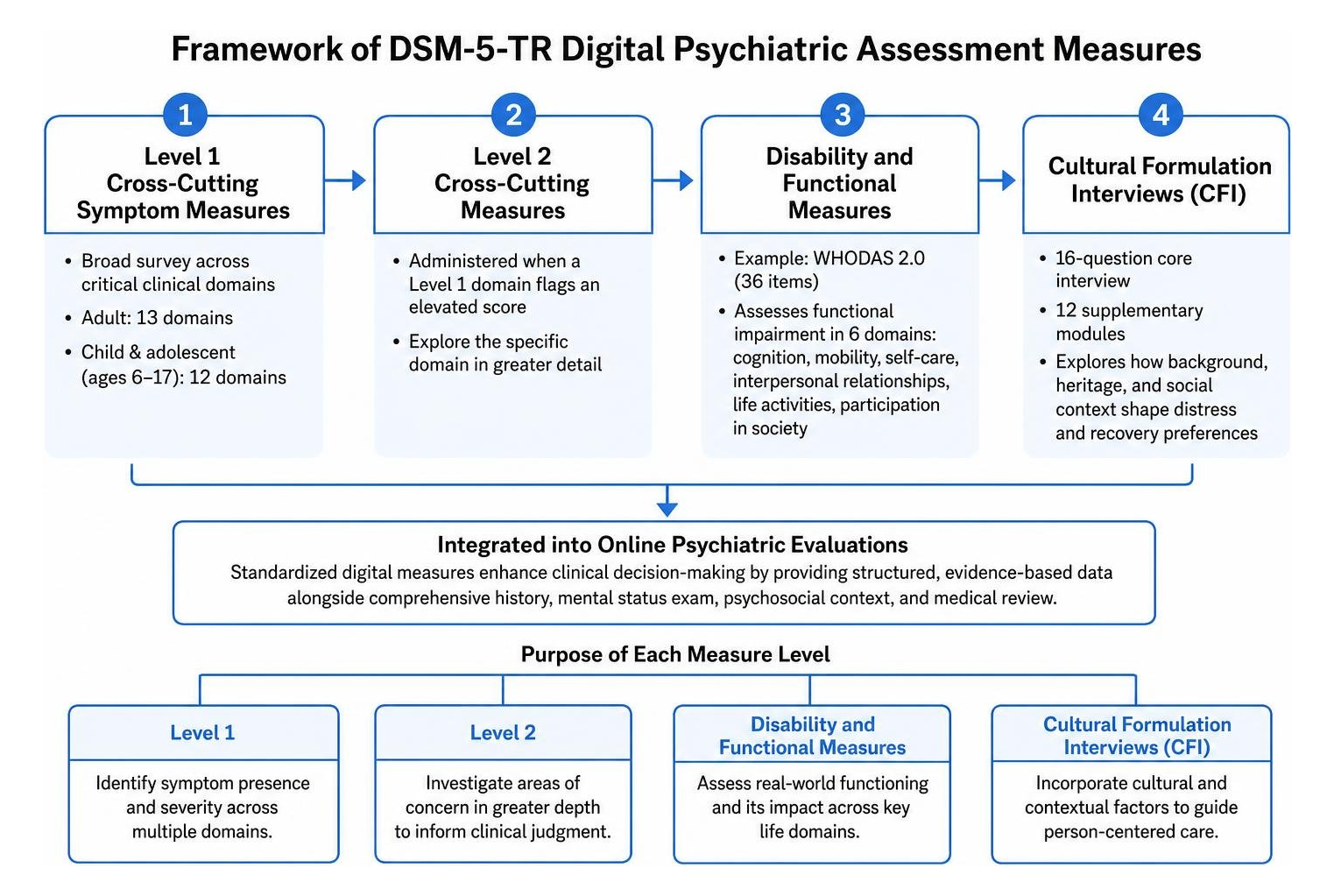
When our psychiatric clinicians conduct online evaluations, we frequently use standardized digital measures published in Section III of the DSM-5-TR to enhance our clinical decision-making. These instruments are categorized into distinct levels:
- Level 1 Cross-Cutting Symptom Measures: These serve as a broad survey across critical clinical domains. The adult version screens 13 domains (including depression, anger, mania, anxiety, somatic symptoms, suicidal ideation, psychosis, sleep problems, memory, repetitive thoughts, dissociation, personality functioning, and substance use). The child and adolescent version (for ages 6 to 17) evaluates 12 domains.
- Level 2 Cross-Cutting Measures: When a Level 1 domain flags an elevated score, our clinicians administer Level 2 measures to explore that specific area in greater detail.
- Disability and Functional Measures: We frequently incorporate tools like the World Health Organization Disability Assessment Schedule 2.0 (WHODAS 2.0). The 36-item WHODAS 2.0 measures functional impairment across six essential life domains: cognition (understanding and communicating), mobility (getting around), self-care, interpersonal relationships (getting along with people), life activities (work, school, and home), and participation in society.
- Cultural Formulation Interviews (CFI): Mental health cannot be understood in a vacuum. The CFI is a 16-question core tool accompanied by 12 supplementary modules that help clinicians understand how your background, heritage, and social setting shape your experience of distress and your recovery preferences.
Clinical Validity and Demographic Considerations
A common question patients ask us in August 2026 is whether a telehealth-based psychiatric assessment carries the same clinical validity as an in-person office visit. Decades of peer-reviewed research confirm that telepsychiatry produces diagnostic accuracy, inter-rater reliability, and treatment outcomes that are equal to traditional in-person clinical care across a wide variety of psychiatric conditions.
Age-Specific Considerations for Online Psychiatric Evaluations
Virtual psychiatric assessments work across the lifespan, but providers adapt their evaluation methods to match the patient’s developmental stage:
- Adults: Adults benefit from the privacy and flexibility of telehealth. Clinicians conduct comprehensive interviews, review medical and psychiatric histories, evaluate cognitive and emotional functioning, and examine workplace and relationship dynamics.
- Children and Adolescents: Pediatric telepsychiatry relies heavily on a multi-informant approach. For children ages 6 to 11, parent-proxy reports and developmental intake forms are critical, often supplemented by teacher observations and school functioning reports. For adolescents ages 11 to 17, our clinicians blend independent adolescent interviews with parent-assisted collateral data to assess social development, mood fluctuations, academic progress, and peer relationships.
- Older Adults: For older populations, virtual visits allow providers to assess cognitive status, screen for late-onset mood disorders, and review complex medication regimens while minimizing travel burdens.
Preparing for Comprehensive Online Psychiatric Evaluations
To get the most out of your virtual psychiatric consultation, preparation is key. Having your background information organized helps your provider make an accurate evaluation:
- Gather Your Medical History: Compile a list of past medical diagnoses, previous surgeries, recent blood work, and your family’s history of mental health conditions.
- List Current Medications: Note all prescription medications, over-the-counter drugs, vitamins, and supplements, including exact dosages and how long you have taken them.
- Build a Symptom Timeline: Write down when you first noticed your symptoms, how frequently they occur, their severity, and any life events or stressors that seem to trigger or worsen them.
- Collect Collateral Records: If you have past therapy discharge summaries, neuropsychological testing reports, or school IEP/504 plans for children, upload these securely prior to your session.
- Set Up a Private, Quiet Space: Use a device with a stable internet connection, a working camera, and a clear microphone in a private room where you can speak openly without interruption.
Next Steps After Receiving Your Evaluation Results
Receiving your clinical evaluation results is an empowering moment. It provides language and clarity for experiences that may have felt confusing or overwhelming. Once your psychiatric provider establishes an accurate diagnostic profile, you will collaborate on a structured, evidence-based care plan.
When deciding how to organize your ongoing care, understanding therapy vs PCP vs psychiatry is essential. While primary care physicians can handle routine mental health concerns, psychiatric specialists possess the deep expertise required for precise differential diagnoses, complex symptom presentations, and tailored psychopharmacology.
Integrating Medication and Psychotherapy
The most robust clinical outcomes often occur when evidence-based psychotherapy and modern psychiatric medication work in harmony. Medication can help stabilize acute biological symptoms—such as severe insomnia, paralyzing panic attacks, intense mood swings, or debilitating depression—creating the mental clarity needed to actively engage in psychotherapy.
At KindMind Behavioral Health, our psychiatric prescribers specialize in careful, conservative medication management. We prioritize finding the lowest effective dose, minimizing side effects, and reviewing your response regularly. If you are starting treatment, learning how to choose the best psychiatric prescriber for you ensures that your provider’s philosophy, communication style, and clinical focus match your specific recovery goals.
Navigating Support and Provider Selection
Finding the right clinical team is an important part of your long-term success. Your treatment network should feel collaborative, empathetic, and attentive to your unique personal background.
When you are exploring your options, our guide on finding a mental health therapist or psychiatrist outlines the credentials, specialties, and questions to ask during an initial consultation. If you are seeking local psychotherapy to complement virtual psychiatric appointments, learning how to find a therapist near me provides a straightforward framework for finding clinicians who specialize in your specific concerns.
Limitations and Safety Boundaries of Telehealth Care
While virtual psychiatric care offers high accessibility and clinical rigor, it has safety boundaries. Telehealth is suited for mild, moderate, and many severe outpatient conditions, but certain high-acuity clinical presentations require direct in-person intervention or specialized settings.
Our guide on understanding the different levels of mental health care explains how care transitions between outpatient visits, intensive outpatient programs (IOP), partial hospitalization programs (PHP), and inpatient stabilization.
Virtual psychiatric assessments are generally not suitable as a standalone intervention for:
- Active, High-Risk Suicidal or Homicidal Ideation: Situations requiring immediate physical containment, constant safety monitoring, or emergency stabilization.
- Acute Substance Withdrawal: Individuals at risk for severe alcohol, benzodiazepine, or opioid withdrawal syndromes that require medically supervised detoxification.
- Severe, Unmanaged Psychosis or Delirium: Acute psychotic states where reality testing is profoundly impaired, or medical delirium requiring urgent physical workups and neurological imaging.
- Unstable Medical Conditions: Eating disorders with severe physical instability (such as dangerously low BMI, abnormal electrolytes, or cardiac arrhythmias) requiring hands-on medical monitoring.
Emergency Protocols and Crisis Resources
If you or a loved one is experiencing an acute mental health emergency, please do not wait for a scheduled virtual appointment. Immediate, free, and confidential crisis support is available 24/7:
- 988 Suicide & Crisis Lifeline: Call or text 988 (available across the United States) to connect with a trained crisis counselor.
- The Crisis Text Line: Text HOME to 741741 to connect with a crisis counselor via text.
- The Trevor Project (LGBTQ+ Youth): Call 1-866-488-7386 or text START to 678-678.
- Veterans Crisis Line: Dial 988 and press 1, or text 838255.
- Emergency Medical Services: Call 911 or visit your nearest hospital emergency department for immediate safety needs.
Frequently Asked Questions About Virtual Psychiatric Assessments
Can an online mental health test provide an official diagnosis?
No. An online mental health test or screening questionnaire cannot provide an official medical or psychiatric diagnosis. These automated instruments are designed to detect common symptoms and measure their severity over a given timeframe.
An official diagnosis requires a comprehensive clinical interview conducted by a licensed psychiatric or mental health professional. During this evaluation, the clinician integrates your self-reported symptoms with your developmental background, medical history, family psychiatric history, mental status exam, and differential diagnostic criteria.
How do Level 1 and Level 2 cross-cutting symptom measures differ?
In the DSM-5-TR assessment framework, Level 1 and Level 2 measures serve complementary roles:
- Level 1 Measures: These function as broad surveys that screen across 13 distinct symptom domains for adults and 12 domains for children and adolescents. They help clinicians quickly identify potential problem areas outside the patient’s primary complaint.
- Level 2 Measures: When a patient scores above the clinical threshold on a Level 1 domain (such as anxiety, depression, mania, or substance use), the clinician administers a Level 2 measure. These tools evaluate that specific domain in depth, providing granular severity ratings that help guide treatment and monitor progress over time.
Can psychiatric medications be prescribed through online evaluations?
Yes, licensed psychiatric providers can prescribe psychiatric medications via telehealth when clinically indicated and in accordance with current state and federal regulations.
During an online evaluation, your psychiatric provider conducts a thorough diagnostic assessment, reviews your medical history, checks for potential drug interactions, and discusses treatment options. If medication is appropriate, prescriptions are sent electronically to your local pharmacy.
Certain controlled substances may require specific in-person evaluations or periodic monitoring depending on applicable state laws and federal telehealth prescribing regulations. Ongoing follow-up appointments are required to monitor efficacy, adjust dosages, and ensure long-term safety.
Conclusion: Taking the Next Step in Mental Health Care
Navigating emotional, behavioral, or psychological challenges can feel daunting, but you do not have to figure it out alone. An accurate, clinician-led psychiatric evaluation brings structure and clarity to your symptoms, turning uncertainty into an actionable path toward recovery.
Whether you are seeking clarity on a complex diagnosis, looking for dedicated psychiatric medication management, or wanting an integrated plan that blends therapy with psychiatric care, timely and compassionate support makes a measurable difference.
If you are ready to explore comprehensive, personalized mental health care tailored to your life, visit KindMind Behavioral Health to schedule an evaluation or explore how our dedicated team of psychiatric prescribers and therapists can support your journey. You can also view our New Clients page to learn how to get started today.
The information in this article is for educational purposes only and is not intended as medical or mental health advice. Individuals should consult a licensed healthcare professional regarding their specific health needs.