
Attachment Based Couples Therapy Explained for Couples Ready to Reconnect
Attachment Based Couples Therapy Explained for Couples Ready to Reconnect
Attachment Based Couples Therapy Explained for Couples Ready to Reconnect
Understanding Attachment and Modern Relationship Stress
Attachment based couples therapy helps partners understand the emotional pattern underneath repeated fights, distance, or fear of being let down. Instead of treating one person as the problem, therapy looks at the cycle between you. You learn to name attachment needs, share them more safely, and respond to each other with more care.
This approach is often helpful when one partner pursues reassurance while the other pulls away, or when both people feel lonely even while living together. The goal is not perfect communication. It is a relationship where both partners can feel emotionally safe, supported, and able to reconnect after conflict.
Attachment theory explains why these moments can feel so intense. In close relationships, many of us ask a basic question: Are you there for me when I need you? When the answer feels uncertain, people may protest, shut down, criticize, avoid, or become overwhelmed. Those responses can reflect anxious, avoidant, or disorganized attachment patterns, not a lack of love.
At KindMind Behavioral Health, couples can explore these patterns in a supportive setting, in person or through telehealth. Our integrated approach also includes psychiatric evaluation and mental health medication management when anxiety, depression, or mood symptoms make relationship work feel harder. We accept most major commercial and non-commercial insurance plans, including Medicaid and Medicare.
Key topics for attachment based couples therapy:
What Is Attachment Based Couples Therapy and How Does It Work?
Attachment based couples therapy is an evidence-based approach rooted in the foundational work of British psychologist John Bowlby. Bowlby established that human beings are biologically wired to seek proximity, comfort, and protection from key figures throughout life. While Bowlby originally focused on parent-infant bonds, modern relationship science confirms that adult romantic partnerships function as primary attachment bonds as well.
In an adult relationship, our romantic partner ideally serves two main emotional functions:
- A Safe Haven: The person you turn to for comfort, soothing, and emotional safety when the outside world feels overwhelming or painful.
- A Secure Base: The solid emotional foundation that gives you the confidence to explore personal goals, career ambitions, and independent interests.
When these functions break down, partners experience separation distress. Over time, individuals form internal working models, which are mental roadmaps created from past relationship experiences about whether other people are reliable and whether one is worthy of love. If a partner learns early in life that closeness brings criticism or abandonment, their protective strategies may manifest as intense anxiety or defensive withdrawal during relationship conflicts. As outlined in Attachment Theory: A Guide for Couple Therapy, shifting these cycles requires fostering emotional responsiveness rather than merely teaching negotiation tactics.
The Core Principles of Attachment Based Couples Therapy
Attachment-oriented therapy operates on several distinct, compassionate tenets:
- Dependency Is Normal and Healthy: Rather than viewing emotional reliance as codependency, attachment theory recognizes that effective mutual dependence strengthens personal autonomy and resilience.
- Reframing Conflict as Separation Distress: Fiery arguments or cold silences are not viewed as malice. They are understood as desperate, protective attempts to handle perceived disconnection or abandonment.
- A Non-Pathologizing Stance: Therapists do not label either partner as defective or broken. Both partners’ behaviors are treated as adaptive strategies shaped by previous life experiences.
- Prioritizing Emotional Attunement over Surface Problem-Solving: Addressing surface arguments about chores, finances, or scheduling rarely creates lasting change if underlying fears of inadequacy or neglect remain untouched.
When relationship distress intersects with individual anxiety, depression, or mood concerns, healing often involves exploring our couples and family therapy services alongside holistic psychiatric evaluations to ensure full emotional support.
Key Interventions and Stages in Attachment Based Couples Therapy

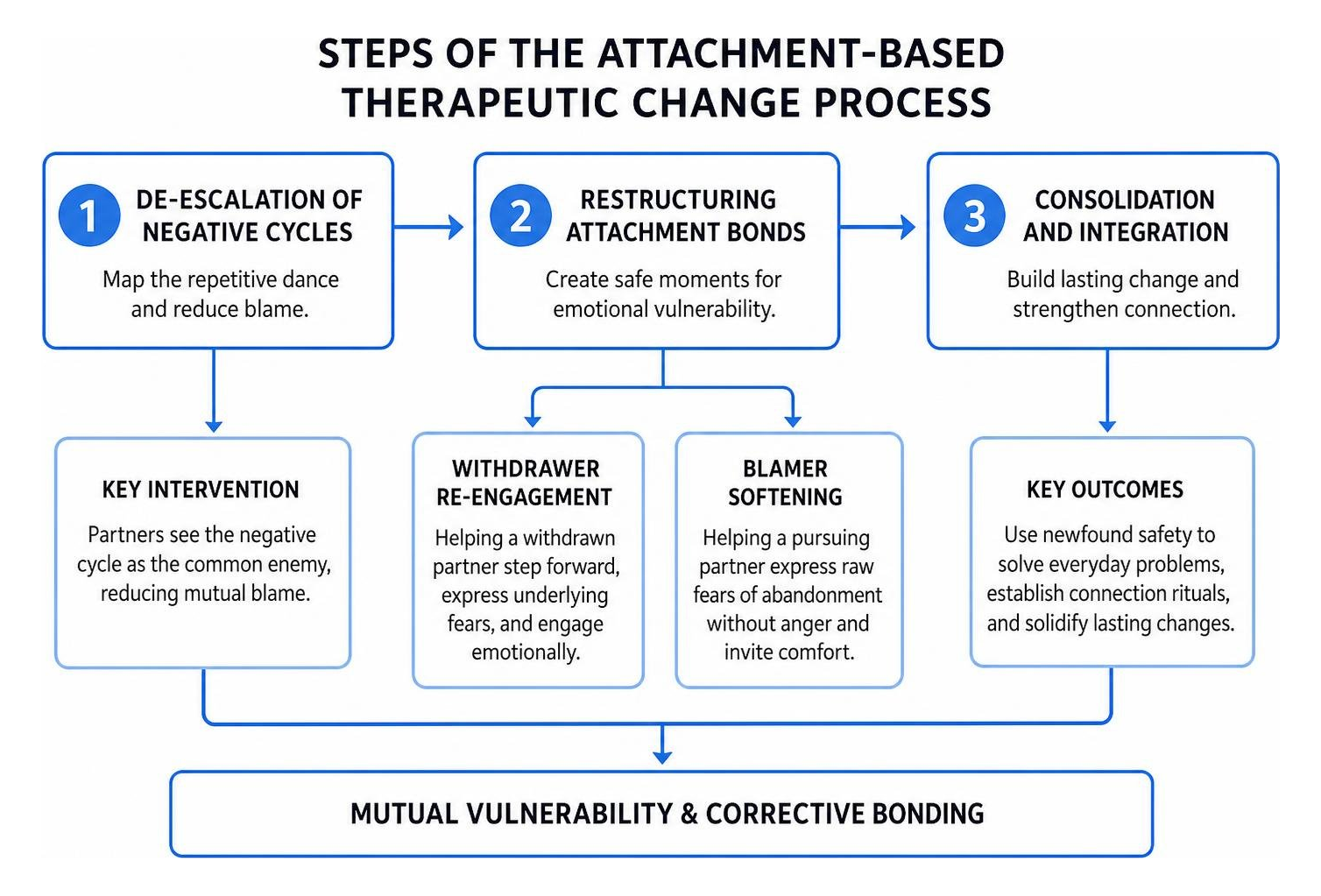
The primary model implementing attachment theory for partners is Emotionally Focused Therapy (EFT), which guides couples through three structured stages:
- De-escalation of Negative Cycles: The therapist helps partners step back from daily arguments to map out their repetitive dance (such as the demand-withdraw cycle). Partners learn to see the negative cycle itself as the common enemy, reducing mutual blame.
- Restructuring Attachment Bonds: In this deeper phase, the therapist creates safe moments for emotional vulnerability. This includes two major clinical events:
- Withdrawer Re-engagement: Helping a protective, withdrawn partner step forward, express their underlying feelings of inadequacy or fear, and engage emotionally.
- Blamer Softening: Helping a critical, pursuing partner express their raw fears of abandonment without anger, inviting their partner to comfort them.
- Consolidation and Integration: Partners use their newfound emotional safety to solve lingering everyday problems, establish shared rituals of connection, and solidify lasting changes in their relationship.
Research on the EFT change process and interventions indicates that these corrective emotional experiences help partners create secure base behaviors and reduce relationship-specific anxiety over time.
Comparing Attachment-Focused Therapy to Behavioral and Acceptance Approaches
When seeking relationship support, couples encounter several established therapeutic frameworks. While all seek to reduce distress, their underlying mechanisms and clinical targets vary significantly.
| Feature / Modality | Emotionally Focused Therapy (EFT / Attachment-Based) | Integrative Behavioral Couple Therapy (IBCT) | Acceptance and Commitment Therapy (ACT) for Couples |
|---|---|---|---|
| Primary Theoretical Basis | Bowlby’s Attachment Theory and Experiential Humanistic Models | Behavioral Systems Theory and Functional Contextualism | Relational Frame Theory and Psychological Flexibility |
| Main Target of Change | Restructuring core emotional bonds and internal working models | Behavioral exchanges, emotional acceptance, and unified detachment | Psychological acceptance, mindfulness, and values-based relationship actions |
| Therapeutic Mechanism | Experiential corrective bonding events (blamer softening, re-engagement) | Empathic joining around problems, tolerance building, and behavior change | Cognitive defusion from unhelpful relationship stories and committed action |
| Focus on Early History | High; explores how childhood attachment shapes current relationship fears | Moderate; examines past patterns primarily as contexts for current reinforcement | Low to moderate; focuses on present-moment awareness and values |
| Key Clinical Goals | Creating emotional accessibility, responsiveness, and secure attachment | Reducing coercive behavioral patterns and building mutual acceptance | Fostering psychological flexibility and living out shared relational values |
Clinical comparisons provide meaningful insight into how these modalities perform. In Research comparing EFCT and ACT outcomes, both approaches significantly improved attachment behaviors in distressed couples (P<0.05), but Emotion-Focused approaches showed greater effectiveness in enhancing accessibility, emotional engagement, and overall secure attachment behaviors, with gains maintained at follow-up assessments.
Does Attachment Change Drive Relationship Satisfaction or Follow It?
An important question explored in clinical research is whether partners must heal their underlying attachment styles before experiencing happiness, or whether improving relationship satisfaction naturally fosters attachment security.
Evidence from The Impact of Behavioral Couple Therapy on Attachment in Distressed Couples shows that early increases in relationship satisfaction strongly predict later reductions in attachment-related anxiety over two years of follow-up (Benson et al., 2013). This suggests a bidirectional dynamic: concrete behavioral improvements that build daily relationship satisfaction help reduce abandonment anxiety, while targeted emotional work reshapes how partners view each other. For partners whose individual attachment wounds create intense distress, combining couples work with individual therapy or psychiatric support provides a balanced path forward.
Attachment Styles in Romantic Relationships: Shifting Insecure Patterns

Our attachment styles act as emotional blueprints that dictate how we respond when connection feels threatened. In therapy, partners identify these strategies without shame:
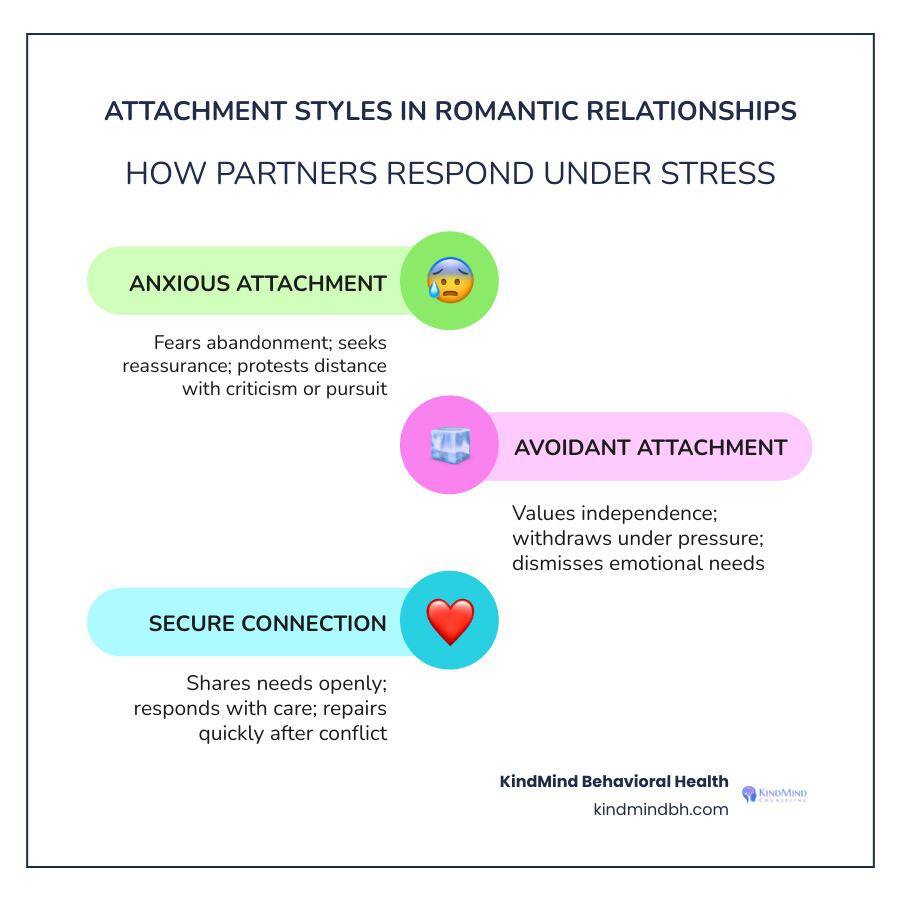
- Anxious (Preoccupied) Attachment: Individuals with high attachment anxiety often fear abandonment or unworthiness. When sensing distance, they may pursue reassurance through frequent calling, criticism, or urgent demands for connection.
- Avoidant (Dismissive) Attachment: Individuals with high attachment avoidance cope with fear by suppressing emotional needs, prioritizing extreme self-reliance, and pulling away during conflict to protect against anticipated rejection or overwhelm.
- Disorganized (Fearful-Avoidant) Attachment: Often stemming from relational trauma or unpredictable caregiving, this style creates a push-pull dynamic where a partner desires intimacy deeply but feels terrified when closeness occurs.
In distressed relationships, these styles frequently lock into a destructive demand-withdraw cycle. One partner feels lonely, protests through criticism, and triggers the other partner’s feeling of failure, causing them to withdraw. This withdrawal confirms the first partner’s fear of abandonment, accelerating the pursuit. Managing the everyday stresses of domestic life can further strain these dynamics, which is why balancing the mental load of your relationship alongside emotional patterns is essential.
The A.R.E. Framework: Accessibility, Responsiveness, and Engagement
To help couples shift from reactive cycles to secure connection, attachment-based therapists rely on the A.R.E. framework:
- Accessibility (Can I reach you?): Being emotionally open and available to your partner, even during moments of disagreement, rather than putting up defensive emotional walls.
- Responsiveness (Can I rely on you to respond to my emotions?): Tuning in to your partner’s emotional cues, validating their distress, and offering comfort when they express vulnerability.
- Engagement (Do I know you value me and will stay close?): Demonstrating focused, invested emotional presence that reassures your partner of their primary importance in your life.
This framework is particularly vital for couples working through significant relational breaches, such as navigating couples therapy infidelity recovery, where emotional safety and reliability must be rebuilt from the ground up.
Who Benefits Most from an Attachment-Oriented Approach?
Attachment based couples therapy is exceptionally versatile and well-suited for a wide range of relational challenges:
- Chronic, Repetitive Conflict: Couples caught in circular arguments where the same underlying issue resurfaces regardless of the surface topic.
- Emotional Distance and Roommate Syndrome: Partners who function well logistically but feel a profound absence of emotional warmth or physical intimacy.
- Couples Navigating Betrayals and Attachment Injuries: Relationships recovering from affairs, major broken promises, or moments of abandonment during critical life events (such as illness or childbirth).
- Premarital Exploration: Partners seeking proactive bonding tools through “A Guide To Pre-Marriage Counseling” to establish secure relational habits early.
- Partners Navigating Mental Health Concerns: When one or both partners manage depression, severe anxiety, or mood disorders, attachment-based work helps partners support one another effectively without emotional burnout.
Comprehensive Mental Health and Psychiatric Care for Couples
At KindMind Behavioral Health, we understand that relationship dynamics do not exist in a vacuum. Relational distress frequently co-occurs with individual mental health conditions, including major depressive disorder, generalized anxiety, panic disorder, adult attention-deficit/hyperactivity disorder (ADHD), and post-traumatic stress. When an individual struggles with untreated chemical imbalances or severe anxiety, engaging in vulnerable attachment dialogues can feel overwhelming.
Our integrated model bridges psychotherapy with comprehensive psychiatric evaluations, psychiatric consultations, and ongoing mental health medication management. Working alongside board-certified psychiatric providers allows our team to address neurochemical factors that contribute to emotional dysregulation, mood reactivity, or withdrawal. By pairing individualized medication management with evidence-based couples counseling, partners gain the emotional stability needed to participate fully in therapeutic exercises, practice emotional attunement, and establish lasting relational security.
If you or a loved one is experiencing severe emotional distress, self-harm concerns, or suicidal thoughts, please know that immediate help is available. This educational content is not a substitute for emergency psychiatric intervention. Please call or text the Suicide & Crisis Lifeline at 988, or visit your nearest emergency room.
Frequently Asked Questions About Attachment-Based Relationship Counseling
How long does it take to see progress in attachment-focused couples therapy?
Most attachment-based therapy protocols, such as Emotionally Focused Therapy, are designed as brief, structured interventions lasting between 8 to 20 weekly sessions. Couples often experience noticeable de-escalation of daily conflicts within the first 6 to 8 sessions as they learn to identify their negative cycle. Deepening vulnerability and consolidating long-term secure attachment behaviors typically occur over the subsequent stages, with clinical studies demonstrating that relationship gains remain stable years after treatment completion.
Can an avoidant or anxiously attached partner develop secure attachment?
Yes. Attachment styles are not permanent personality traits; they are adaptable behavioral strategies. Through the process of adult neuroplasticity and corrective emotional experiences in therapy, individuals can develop what psychologists term “earned security.” When a partner consistently experiences accessibility and emotional attunement in their relationship, their brain revises its internal working models, allowing them to feel safe in closeness and resilient in autonomy.
How do therapists assess attachment patterns during couples sessions?
Therapists assess attachment through a combination of standardized clinical measures, detailed relationship histories, and live in-session observations. Clinicians may utilize validated questionnaires such as the Experiences in Close Relationships (ECR) scale alongside behavioral assessment tools like the Secure Base Scoring System. In therapy sessions, the clinician closely maps how each partner physically and verbally responds to emotional distress, non-verbal cues, and moments of vulnerability to identify active attachment triggers.
Rebuilding Lasting Bonds and Emotional Safety
Every couple deserves a relationship that serves as a haven of comfort, mutual respect, and emotional resilience. Learning to decode the attachment needs beneath relationship conflicts allows partners to transform chronic tension into deep, lasting connection.
At KindMind Behavioral Health, our collaborative team of therapists and psychiatric medical providers is dedicated to supporting individuals and couples across Michigan. Whether you are looking for in-person counseling at our welcoming offices in Clarkston and Rochester, or prefer flexible virtual teletherapy services across Detroit and Oakland County, we provide comprehensive, personalized care tailored to your unique journey.
We believe high-quality mental healthcare should be accessible. KindMind accepts most major commercial and non-commercial insurance plans, including Aetna, ASR, Blue Care Network, Blue Cross Blue Shield, Blue Cross Complete, Cigna, Cofinity/Varipro, Health Alliance Plan (HAP), Humana, McLaren, Medicaid, Medicare, Meridian, Meritain, Priority Health, TRICARE East, and UnitedHealthcare/Optum.
Ready to transform your relationship dynamic and restore emotional closeness? Book an appointment or consultation with KindMind Behavioral Health today to take the next step toward healing together.
The information in this article is for educational purposes only and is not intended as medical or mental health advice. Individuals should consult a licensed healthcare professional regarding their specific health needs.