

Demystify Couples Counseling Cost Before Booking Your First Session
Demystify Couples Counseling Cost Before Booking Your First Session
Understanding Average Couples Counseling Cost in 2026
When budgeting for relationship support, understanding national and international price structures helps you plan effectively. Standard private practice rates across the United States typically land between $150 and $300 for an hour-long appointment, though specialized sessions ranging from 75 to 90 minutes often fall between $200 and $350.
Geographic location plays a massive role in shaping these rates. For instance, urban hubs with high operating overheads sit at the top of the price range, whereas suburban and rural practices remain closer to the baseline. For a wider perspective on international benchmarks, this Couples Therapy Cost by Country: A 2026 Price Guide highlights how costs translate across private and public healthcare systems worldwide.
| Setting / Region | Typical Session Duration | Estimated Cost Per Session | Notes / Inclusions |
|---|---|---|---|
| Major US Metro (NYC, LA, SF) | 50–60 minutes | $250 – $400+ | Higher overhead; deep specialization |
| Mid-Sized US Cities / Suburban | 50–60 minutes | $150 – $250 | Closest to the national average ($200) |
| Rural US / Lower-Cost States | 50–60 minutes | $100 – $160 | Lower clinic operating overhead |
| United Kingdom (Private) | 50–60 minutes | £60 – £150 ($75 – $190 USD) | London rates typically start at £90 |
| Australia (Private Pay) | 50–60 minutes | AUD $150 – $300 ($100 – $200 USD) | Psychologist rates often sit at AUD $230+ |
| University Graduate Clinics | 50–60 minutes | $20 – $80 | Supervised master’s/doctoral trainees |
| Online Subscription Platforms | Weekly messaging + 1 live call | $60 – $100 / week | Billed every 4 weeks ($260–$400/cycle) |
Factors That Influence Couples Counseling Cost
Therapy fees are not pulled out of thin air. They reflect a combination of direct clinical expenses, rigorous education, and the geographic market where the provider operates.
- Geographic Location: A practice operating in Manhattan or downtown San Francisco faces substantially higher commercial leases, administrative overhead, and insurance burdens than a practice in Mississippi or West Virginia.
- Clinician Credentials and Experience: A Licensed Professional Counselor (LPC) or Licensed Clinical Social Worker (LCSW) generally charges between $100 and $250 per session. In contrast, Licensed Marriage and Family Therapists (LMFTs) average $150 to $300, and Clinical Psychologists (PhD or PsyD) often charge $200 to $400+ per hour due to their extensive doctoral training.
- Specialized Certifications: Clinicians certified in evidence-based couples frameworks—such as the Gottman Method, Emotionally Focused Therapy (EFT), or Imago Relationship Therapy—invest significant time and capital into advanced post-graduate supervision.
- Session Duration: While individual therapy relies almost universally on the 50-minute clinical hour, couples therapy often uses 75- to 90-minute blocks so both partners have adequate time to speak without rushing.
When exploring local options, learning how to find a therapist nearby can help you compare qualified providers in your immediate area.
Why Relationship Therapy Differs in Price from Individual Sessions
Many couples wonder why two people sitting in a room costs more than one person sitting in that same room. The reason comes down to clinical complexity and session structure.
Treating a relationship is not simply doing individual therapy twice in the same room; the relationship itself is the client. Navigating dynamic interpersonal conflicts, de-escalating emotional reactivity, and balancing both voices requires advanced systemic training.
Furthermore, relational distress often surfaces intertwined with chronic stress, emotional exhaustion, and the mental load of your relationship, requiring therapists to manage intricate multi-person dynamics without taking sides. Because 50 minutes can pass quickly when two people are speaking, extended 75- to 90-minute formats are standard, which naturally increases the per-session investment.
Therapy Modalities and Pricing: Gottman, EFT, and Specialized Care
Evidence-based relationship modalities like the Gottman Method and Emotionally Focused Therapy (EFT) offer highly structured interventions. Because these modalities require extensive post-graduate certification, practitioners often charge premium session rates ranging from $220 to $300+ per 80-to-90-minute appointment. For a complete look at these fee structures, explore this Gottman Therapy Cost: Complete 2026 Pricing Guide.
For couples dealing with acute distress, infidelity recovery, or severe communication breakdowns, multi-day intensives provide an accelerated alternative to weekly appointments:
- Half-Day Intensives (4 hours): $800 – $1,200
- Full-Day Intensives (6–8 hours): $1,500 – $3,000
- Multi-Day Marathon Therapy (2–3 days): $3,000 – $6,000+
While intensives require a significant upfront expense, their hourly cost (roughly $200 to $250 per hour) remains comparable to weekly sessions while compressing months of therapeutic progress into a few focused days.
Assessment Phases vs. Ongoing Relational Work
Most structured modalities begin with an intake and assessment sequence before transitioning into regular intervention sessions. Under the Gottman Method, for instance, this process involves:
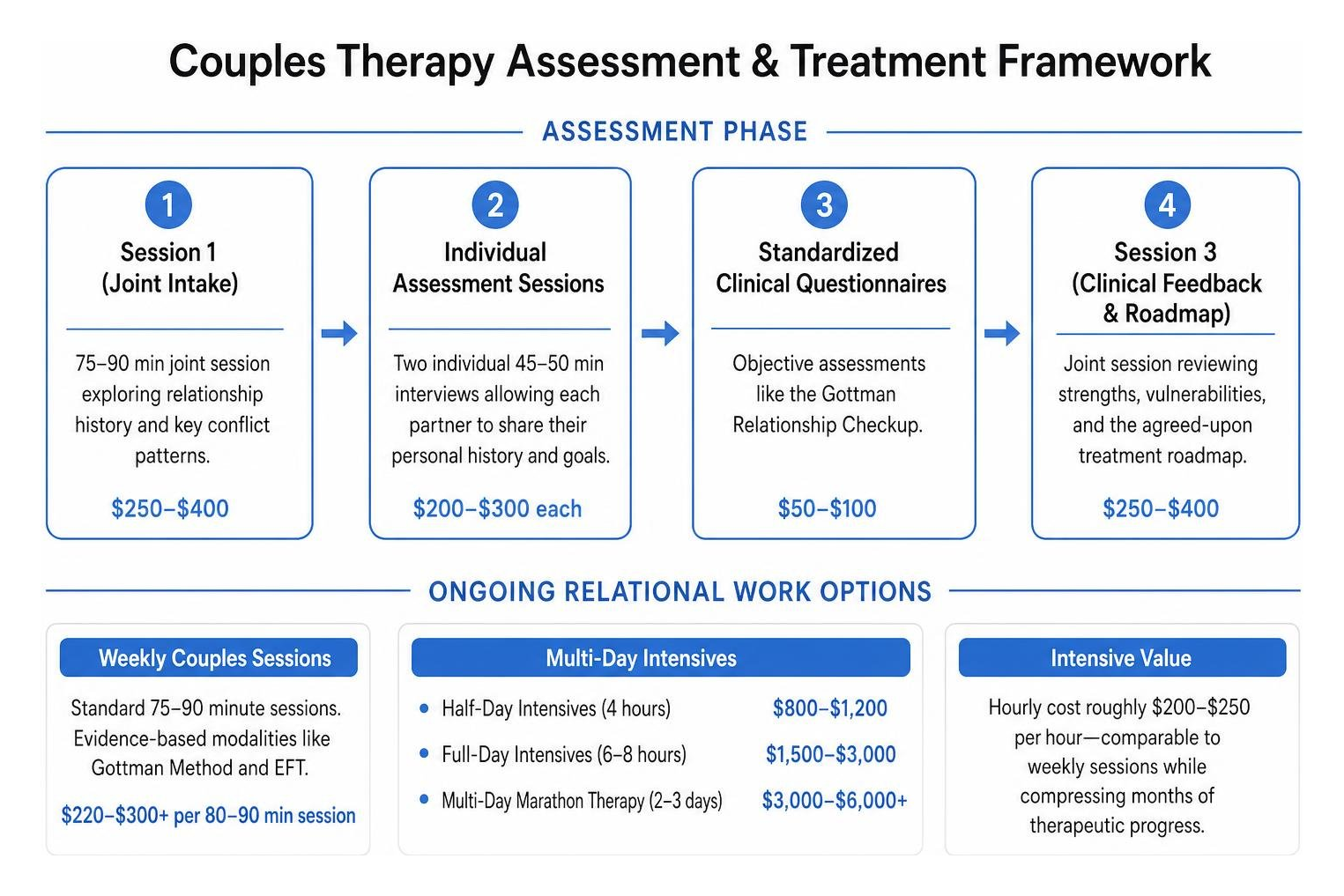
- Session 1 (Joint Intake): A 75-to-90-minute joint session exploring the relationship history and key conflict patterns ($250–$400).
- Individual Assessment Sessions: Two individual 45-to-50-minute interviews allowing each partner to share their personal history and goals ($200–$300 each).
- Standardized Clinical Questionnaires: Objective assessments like the Gottman Relationship Checkup ($50–$100).
- Session 3 (Clinical Feedback & Roadmap): A joint session reviewing strengths, vulnerabilities, and the agreed-upon treatment roadmap ($250–$400).
Altogether, the initial diagnostic assessment phase typically costs between $700 and $1,000. Couples planning long-term commitments often find that working through a guide to pre-marriage counseling helps establish strong communication foundations before entrenched conflicts develop.
Does Insurance Cover Couples Counseling? Navigating Coverage and Codes

A common point of confusion is whether commercial health insurance covers couples counseling. In most cases, standard insurance plans do not pay for relationship counseling simply to improve communication, resolve general conflict, or enrich a marriage.
Insurance companies operate under a standard of medical necessity. Under the Diagnostic and Statistical Manual of Mental Disorders (DSM-5-TR), general relationship distress or relational conflict (often categorized as “Z-codes” such as Z63.0) is not classified as a billable mental health disorder.
Insurance coverage is typically approved only when one partner meets diagnostic criteria for a recognized clinical mental health condition (such as Major Depressive Disorder, Generalized Anxiety Disorder, or PTSD), and joint sessions are deemed medically necessary to treat that individual’s condition.
The standard billing codes used for couples and family therapy include:
- CPT Code 90847: Family or couples psychotherapy with the patient present (typically 50 minutes). Billed under the identified patient’s insurance plan.
- CPT Code 90846: Family or couples psychotherapy without the patient present (rarely used for general couples work).
- CPT Code 90837 / 90834: Standard individual psychotherapy codes (53+ minutes and 45 minutes, respectively).
When psychiatric conditions like clinical anxiety or depression intersect with relational discord, reviewing the differences between therapy vs. primary care vs. psychiatry helps clarify how integrated medical and mental health care works together.
Using HSA, FSA, and Out-of-Network Reimbursement
If your therapist does not accept your insurance directly, you can still leverage tax-advantaged accounts or out-of-network benefits:
- Health Savings Accounts (HSA) & Flexible Spending Accounts (FSA): You can pay for therapy using pre-tax funds from an HSA or FSA when services relate to treating an individual’s diagnosed condition, saving approximately 20% to 30% depending on your tax bracket.
- Superbill Submission: Out-of-network providers can supply a comprehensive itemized receipt (a “superbill”) that you submit to your insurer for potential reimbursement.
- Understanding the “Allowable Amount”: Insurance reimbursement is calculated based on the insurer’s predetermined allowable rate, not the therapist’s billed rate. If your therapist charges $250, but your insurer sets the allowable rate at $150 and covers 60% after your deductible, you receive $90 back—leaving your net out-of-pocket cost at $160.
To explore all potential care pathways, read our guide on finding the right fit with a therapist or psychiatry provider.
In-Person vs. Virtual Formats and Affordable Alternatives
Virtual therapy has made relationship support far more accessible, particularly for dual-income households, parents balancing childcare, or couples living in rural areas.
Research indicates that virtual relationship counseling delivers clinical efficacy comparable to in-person sessions. While individual private-practice telehealth rates are generally similar to in-person appointments ($150–$250 per session), virtual sessions eliminate travel time, parking fees, and child care costs. For families navigating multi-person dynamics, family therapy online demonstrates how remote modalities effectively address shared challenges like anxiety and ADHD.
When private practice rates stretch your budget, several low-cost alternatives can provide quality care:
- University Graduate Training Clinics: Academic departments training master’s and doctoral students in marriage and family therapy or clinical psychology offer services on a sliding scale ($20–$80 per session). All student clinicians are supervised directly by licensed faculty.
- Community Mental Health Centers: Non-profit community clinics provide income-adjusted fees, often scaling from $30 to $100 per session.
- Employee Assistance Programs (EAPs): Many employers offer EAP benefits that cover 3 to 8 free, short-term counseling sessions per issue.
- Relationship Workshops and Self-Guided Courses: Structured educational weekend workshops (such as the Gottman Art and Science of Love, ranging from $350 online to $850 in-person) provide foundational tools at a fraction of ongoing therapy costs.
Long-Term Value vs. Total Couples Counseling Cost
A full course of relationship counseling usually lasts between 8 and 20 sessions, with 12 sessions serving as a common baseline. At an average out-of-pocket rate of $200 per session, a 12-week course totals roughly $2,400.
While $2,400 is a meaningful financial investment, it is helpful to place that number alongside the alternatives. In the United States, the average legal cost of a divorce ranges from $15,000 to $30,000 per couple in attorney and court fees alone—excluding the division of shared assets, duplicate housing expenses, and ongoing emotional disruption.
Investing in early, proactive relational support helps couples resolve chronic gridlock, build communication resilience, and rebuild mutual trust before minor friction turns into structural damage. Explore how our team supports partnerships through couples & family therapy.
Frequently Asked Questions About Couples Counseling Cost
How much does couples counseling cost per session without insurance?
Without insurance, standard couples counseling in the United States costs between $150 and $300 per session, with a national average of roughly $200 per hour. Rates range from $100 to $160 in lower-cost rural areas to $250 to $400+ in major metropolitan cities. Specialized modalities like the Gottman Method or Emotionally Focused Therapy (EFT) typically range from $220 to $300 per extended 80-to-90-minute session.
Why is couples therapy rarely covered by insurance?
Health insurance policies require medical necessity, meaning treatment must address a diagnosed mental health disorder outlined in the DSM-5-TR. Relationship distress, communication problems, and general marital dissatisfaction are categorized as relational issues rather than individual psychiatric disorders. For insurance to cover conjoint therapy (typically under CPT code 90847), one partner must carry a qualifying clinical diagnosis, and the therapy must be necessary to treat that condition.
How many sessions of couples therapy are typically needed?
Most couples complete a targeted course of treatment lasting between 8 and 20 sessions, with 12 sessions being the standard baseline. Treatment usually begins with weekly sessions during the assessment and active intervention phases, tapering to bi-weekly and monthly maintenance sessions as communication patterns stabilize.
Conclusion
Understanding couples counseling costs allows you and your partner to approach therapy as an informed, intentional investment in your shared future. Rather than waiting for communication breakdowns to escalate into acute crises, budgeting for proactive relational care provides the structure, clinical guidance, and emotional tools needed to build a resilient partnership.
At KindMind Behavioral Health, we offer comprehensive, patient-centered care that combines individual therapy, psychiatry, and couples counseling through flexible in-person and virtual formats. For couples seeking value-aligned support, our clinicians also provide specialized care such as Christian marriage counseling. Contact our team today to learn more about our providers, verify your benefits, and schedule your first session.
The information in this article is for educational purposes only and is not intended as medical or mental health advice. Individuals should consult a licensed healthcare professional regarding their specific health needs.