
Dialectical Behavior Therapy Offers a Clear Path Through Deep Depression
Dialectical Behavior Therapy Offers a Clear Path Through Deep Depression
Understanding How DBT Therapy for Depression Works
DBT therapy for depression is an evidence-based psychotherapy that treats depressive symptoms by balancing emotional validation with active behavioral change. Rather than simply challenging negative thoughts, Dialectical Behavior Therapy (DBT) teaches practical coping skills across four key areas—mindfulness, distress tolerance, emotion regulation, and interpersonal effectiveness—to help individuals manage overwhelming emotions, reduce emotional numbness, and break cycles of depressive withdrawal.
For those experiencing profound major depression, standard advice—such as “just think positive” or “look at the bright side”—can feel invalidating. DBT was built on the premise that before you can successfully change an unhelpful pattern, you must first acknowledge and validate the reality of your current emotional state.
At its core, DBT relies on a philosophical concept known as dialectics: the idea that two seemingly opposite truths can exist side by side. In the context of depressive disorders, this means:
- Acceptance: You are doing the absolute best you can with the internal resources, emotional energy, and pain you are carrying right now.
- Change: You need to learn new skills and behaviors to feel better and create a life that feels meaningful and sustainable.
By merging the grounded awareness of Zen mindfulness with evidence-based behavioral activation, DBT helps individuals step out of chronic emotional numbness and despair. Instead of spiraling into self-blame when negative moods strike, individuals learn distress tolerance skills to navigate the storm without turning to self-destructive coping mechanisms.
The Core Difference Between DBT and CBT
Both Cognitive Behavioral Therapy (CBT) and Dialectical Behavior Therapy (DBT) are gold-standard, evidence-based approaches, but their mechanisms and emotional tones differ significantly.
Standard CBT relies heavily on cognitive restructuring. Influenced by classical Stoic philosophy and the Socratic method, CBT encourages you to examine your thoughts as hypotheses, identify cognitive distortions (like catastrophizing or black-and-white thinking), and replace them with rational, balanced perspectives.
DBT, by contrast, focuses heavily on emotion regulation and validation strategies. If you are experiencing overwhelming sadness or emotional paralysis, DBT does not immediately ask you to debate your thoughts. Instead, it validates the genuine weight of your feelings, helps soothe your nervous system, and uses detailed behavioral chain analysis to uncover what triggered the depressive drop.
When you participate in individual therapy, understanding these operational differences helps ensure you receive the therapeutic model best suited to your needs:
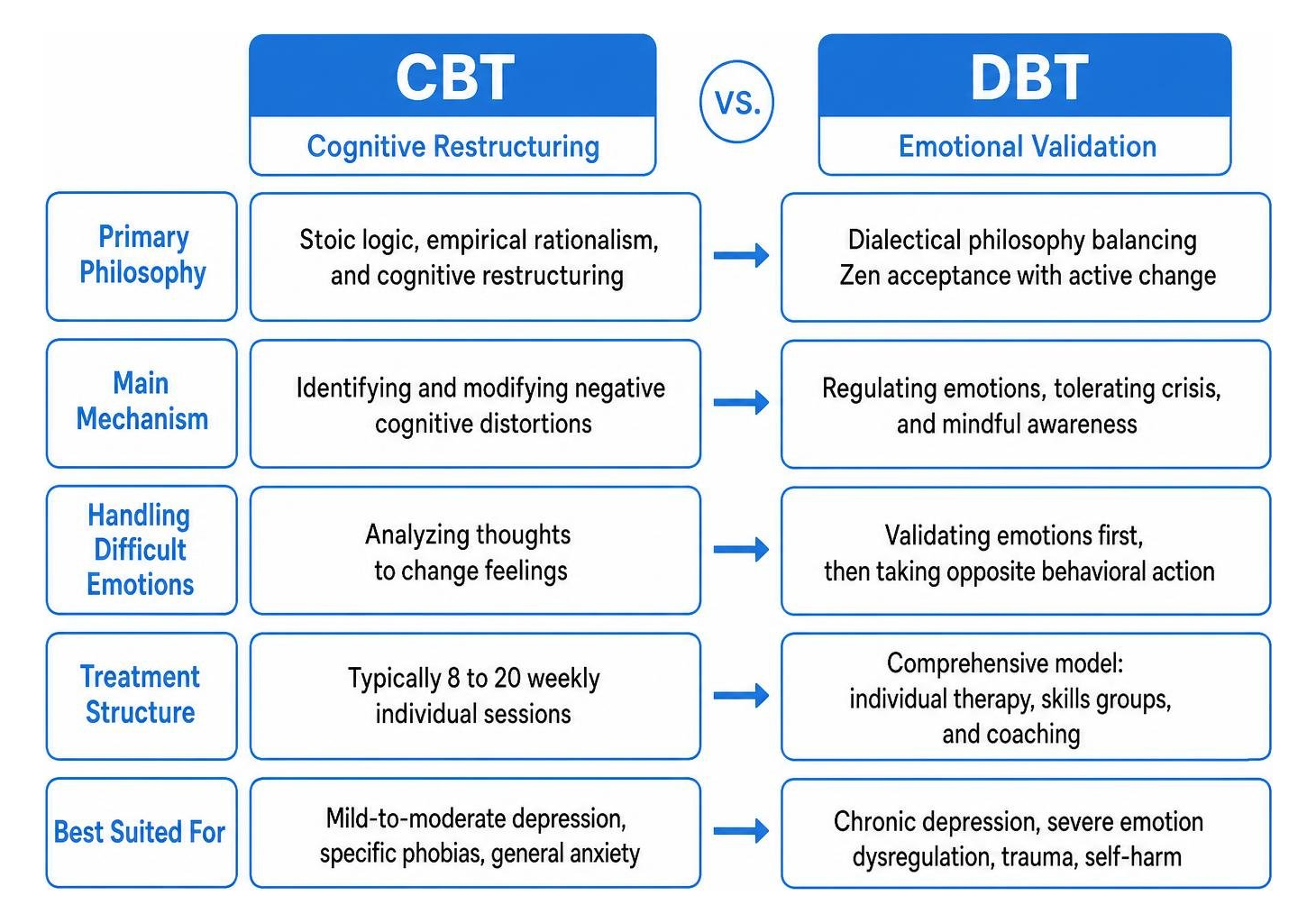
| Feature | Cognitive Behavioral Therapy (CBT) | Dialectical Behavior Therapy (DBT) |
|---|---|---|
| Primary Philosophy | Stoic logic, empirical rationalism, and cognitive restructuring | Dialectical philosophy balancing Zen acceptance with active change |
| Main Mechanism | Identifying and modifying negative cognitive distortions | Regulating emotions, tolerating crisis, and mindful awareness |
| Handling Difficult Emotions | Analyzing thoughts to change feelings | Validating emotions first, then taking opposite behavioral action |
| Treatment Structure | Typically 8 to 20 weekly individual sessions | Comprehensive model: individual therapy, skills groups, and coaching |
| Best Suited For | Mild-to-moderate depression, specific phobias, general anxiety | Chronic depression, severe emotion dysregulation, trauma, self-harm |
Core Skills Taught in DBT Therapy for Depression
DBT organizes practical coping strategies into four distinct modules. When targeted specifically toward depressive episodes, these skills provide a concrete toolkit to replace isolation and exhaustion with intentional action. When exploring evidence-based depression care, these four skill domains form the foundation of sustainable recovery:
- Mindfulness Skills: Depression frequently pulls attention backward into past regret or forward into dread. Mindfulness teaches you how to observe internal sensations and external surroundings without self-criticism, anchoring you firmly in the present moment.
- Distress Tolerance (Crisis Survival): When emotional pain peaks, the goal is not immediate joy—it is surviving the crisis without making the situation worse. Skills like the TIPP technique (Temperature, Intense exercise, Paced breathing, Paired muscle relaxation) physically reset an overwhelmed nervous system, while Radical Acceptance helps stop the compounding suffering that comes from fighting unchangeable realities.
- Emotion Regulation: This module breaks down the anatomy of an emotion. A central technique for depression is Opposite Action: when depression urges you to stay under the covers in a dark room, you intentionally take a gentle, structured step in the opposite direction (e.g., opening the blinds, drinking water, or going for a brief walk).
- Interpersonal Effectiveness: Depressive withdrawal often strains social connections, leading to loneliness. DBT teaches structured communication scripts—such as DEAR MAN (Describe, Express, Assert, Reinforce, Mindful, Appear confident, Negotiate)—so you can voice needs, set boundaries, and ask for help without guilt.
Clinical Evidence and Effectiveness of DBT for Depressive Disorders
Decades of clinical research underscore the power of behavioral and dialectical interventions for mood disorders. While standard CBT is the most extensively researched psychotherapeutic intervention globally—with a comprehensive meta-analysis of behavioral interventions across 409 trials and 52,702 patients demonstrating a strong effect size (Hedges’ g = 0.79) compared to control conditions—DBT has emerged as an essential intervention for complex and treatment-resistant presentations.
In standard meta-analytic research, CBT achieved a 42% response rate and a 36% remission rate (compared to 19% and 15% in control conditions, respectively). Furthermore, behavioral therapies demonstrated superior long-term durability compared to pharmacotherapy alone at 6- to 12-month follow-ups (g = 0.34).
However, when depressive episodes are complicated by co-occurring issues or emotional volatility, standard short-term protocols can sometimes fall short. A landmark network meta-analysis on complex behavioral therapies examining 15,248 participants revealed that “ultra-complex” multi-component interventions—protocols combining core behavioral principles with two or more specialized skill modules such as distress tolerance and emotion regulation—yielded the highest overall symptom reduction (s.m.d. = -1.45) and maintained significant benefits at 26 weeks post-treatment (s.m.d. = -1.09).
Tracking these milestones is an integral part of measuring therapy progress, allowing clinicians and clients to celebrate subtle shifts in coping before full symptom remission takes place.
Who Benefits Most from DBT Therapy for Depression?
Originally developed by Dr. Marsha Linehan to treat Borderline Personality Disorder and chronic suicidality, DBT has expanded across the psychiatric landscape. It is particularly effective for individuals whose depression does not look like simple, quiet sadness, but rather presents as an intense emotional roller coaster.
DBT is uniquely suited for:
- Treatment-Resistant Depression: Individuals who have tried standard talk therapy or multiple antidepressant medications without lasting relief.
- Depression with High Emotion Dysregulation: People who experience extreme mood swings, intense irritability, or sudden drops into despair.
- Co-Occurring Impulsivity or Self-Harm: Individuals who cope with emotional numbness or overwhelming pain through impulsive, harmful behaviors.
- Comorbid Trauma and Personality Traits: When depressive symptoms are intertwined with developmental trauma, chronic invalidation, or relational instability. Pairing DBT with trauma-informed mental health support helps address both deep wounds and immediate coping deficits.
For individuals facing severe, disruptive symptoms, navigating different levels of care ensures they find the right intensity—ranging from outpatient therapy to intensive outpatient programs (IOP).
When Standard CBT May Be the Better Starting Point
While DBT is exceptionally powerful, it is not always necessary as a first step for every form of depression. Standard CBT remains an outstanding, highly efficient choice for:
- Mild-to-Moderate Unipolar Depression: Situations where the primary drivers are negative thought loops, workplace burnout, or situational stressors.
- Clients Seeking Short-Term, Structured Care: Those looking for a time-limited intervention (8 to 16 sessions) focused on tangible weekly problem-solving.
- Individuals with Strong Baseline Distress Tolerance: People who can readily examine and dispute thoughts without feeling emotionally overwhelmed by the process.
Establishing clear objectives during early sessions by setting therapy goals helps determine whether a structured CBT framework or a more expansive DBT skill protocol is the ideal path forward.
Integrating DBT with CBT and Medication Management

Mental health care is rarely one-size-fits-all. In modern clinical practice, the most durable outcomes often emerge from integrating complementary modalities. Rather than viewing CBT, DBT, and psychiatry as competing approaches, combining them creates a comprehensive support system.
For instance, a therapist might use CBT’s cognitive restructuring to help you challenge deep-seated beliefs of unworthiness, while drawing upon DBT’s distress tolerance when an acute depressive crisis makes logical thinking impossible.
Clinical research strongly supports multimodal care for persistent depression. The landmark CoBalT trial on adjunctive therapy demonstrated that adding structured behavioral psychotherapy to ongoing antidepressant medication more than doubled the 6-month response rate (46.1% vs. 21.6%) for treatment-resistant depression compared to medication alone. Meta-analyses confirm that combining psychological therapy with pharmacotherapy delivers superior short-term (g = 0.51) and long-term (g = 0.32) symptom relief.
At KindMind Behavioral Health, we prioritize combining therapy skills with medication within an integrated team. This collaborative model ensures your therapist and psychiatric provider stay in close communication, aligning behavioral goals with medical management to support long-term relapse prevention strategies.
Standard Treatment Structure and Delivery Formats
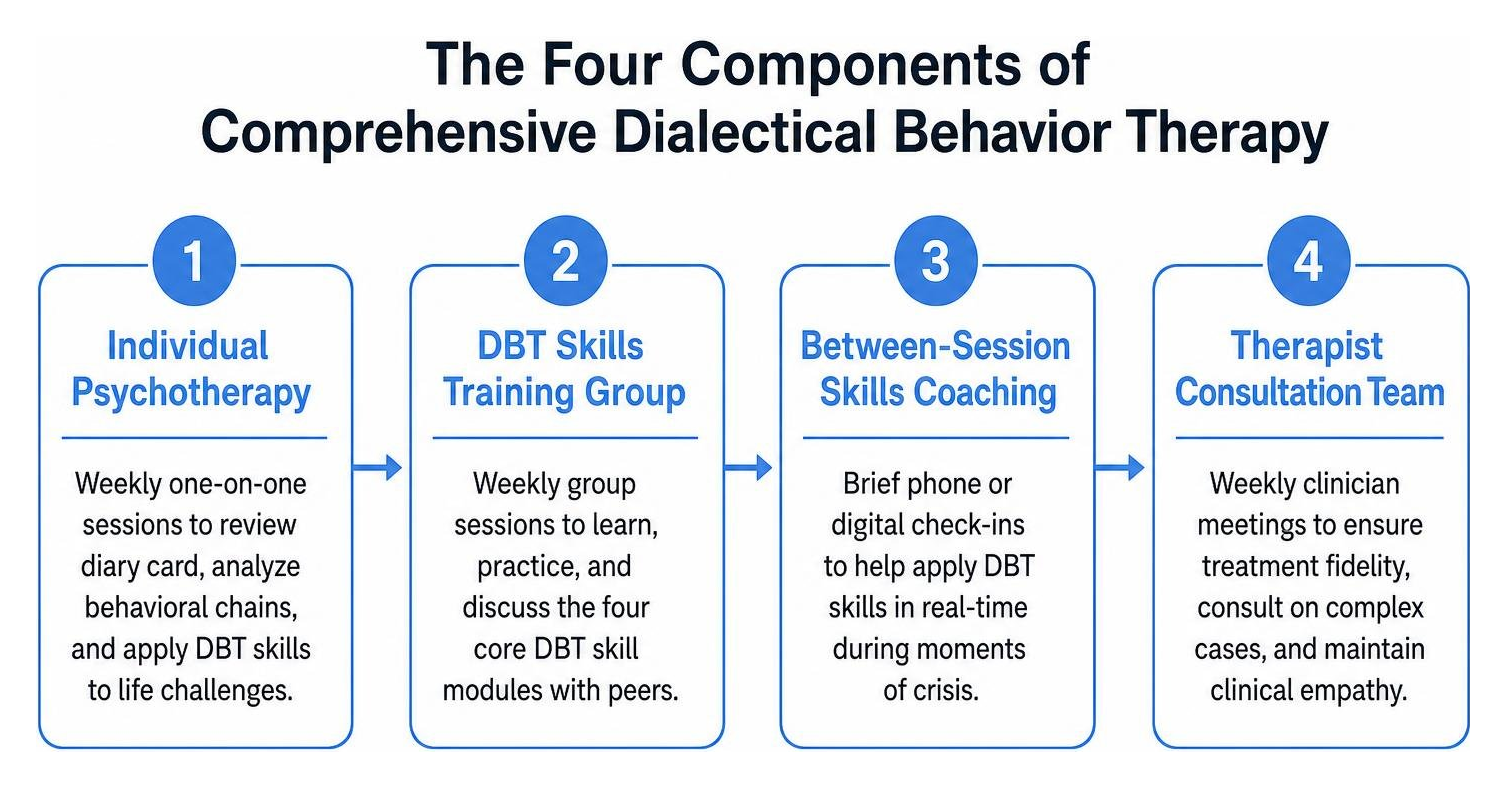
Comprehensive, adherent DBT is traditionally delivered through four structured components:
- Individual Psychotherapy (Weekly): One-on-one sessions where you and your therapist review your weekly diary card, analyze behavioral chains, and apply DBT skills to direct life challenges.
- DBT Skills Training Group (Weekly): A structured, classroom-like environment where you learn, practice, and discuss the four core skill modules alongside peers.
- Between-Session Skills Coaching: Brief phone or digital check-ins designed to help you apply specific DBT techniques in real-time during moments of crisis.
- Therapist Consultation Team: Clinicians meet weekly to ensure treatment fidelity, consult on complex cases, and maintain clinical empathy.
In recent years, flexible and digital delivery formats have expanded access to evidence-based care. Recent clinical trials exploring therapist-guided online interventions have shown that structured, guided digital modules combined with clinician check-ins achieve substantial symptom reduction (d = -0.7 to -0.8) and high treatment retention.
Whether delivered in-person or virtually, starting therapy begins with understanding the basics outlined in a beginner’s guide to psychotherapy.
Frequently Asked Questions About Depression Psychotherapy
How long does DBT take to improve severe depression symptoms?
Standard comprehensive DBT programs are typically designed as a 6- to 12-month commitment to allow full coverage and practice of all four modules. However, many individuals begin experiencing measurable improvements in distress tolerance and emotional stabilization within the first 6 to 8 weeks.
Sustainable recovery takes time because DBT focuses on rewiring deep behavioral habits and neural pathways. If you are beginning treatment, understanding why therapy takes time can help normalize the initial learning curve as you build new coping foundations.
Can DBT techniques be used alongside antidepressant medication?
Yes, DBT techniques integrate exceptionally well with psychiatric medication management. Antidepressants can help raise baseline neurochemical functioning and alleviate physical exhaustion, creating the emotional bandwidth necessary to engage in DBT skills training.
If you are uncertain where to begin your treatment journey, choosing between therapy and psychiatry can clarify how individual therapy, primary care, and psychiatric providers work together to address mood disorders.
How do I know if my depression requires DBT rather than standard talk therapy?
Standard talk therapy is excellent for processing life transitions, general stress, and exploring interpersonal relationships. However, DBT is recommended if your depression is accompanied by:
- Overwhelming emotional intensity that feels uncontrollable
- Frequent urges toward self-harm, severe avoidance, or impulsive behavior
- A history of feeling that standard talk therapy was too unstructured or invalidating
- Difficulty applying coping tools during active crises
Working with a skilled clinician and finding the right clinical fit ensures you receive an accurate evaluation and a treatment plan tailored to your symptom profile.
Conclusion
Deep depression can make you feel disconnected from yourself, your loved ones, and the world around you. When logic alone fails to shift the fog, Dialectical Behavior Therapy provides a practical, validating, and evidence-based roadmap forward. By honoring your present emotional pain while equipping you with concrete tools for mindfulness, distress tolerance, emotion regulation, and interpersonal communication, DBT helps you move from merely surviving to building a rich, engaged life.
At KindMind Behavioral Health, we believe nobody should have to navigate complex mood disorders in isolation. Our multidisciplinary team offers comprehensive, patient-centered care—seamlessly integrating individual psychotherapy, DBT-informed skill building, and psychiatric medication management across both virtual and in-person settings.
If you or a loved one are ready to break free from chronic depression, explore our holistic mental health treatment options today and take the first step toward lasting healing.
The information in this article is for educational purposes only and is not intended as medical or mental health advice. Individuals should consult a licensed healthcare professional regarding their specific health needs.