

An Essential Guide to Pre-Marriage Counseling Benefits & Process
An Essential Guide to Pre-Marriage Counseling Benefits & Process
An Essential Guide to Pre-Marriage Counseling Benefits & Process
How Pre-Marriage Counseling Helps You Prepare for Marriage
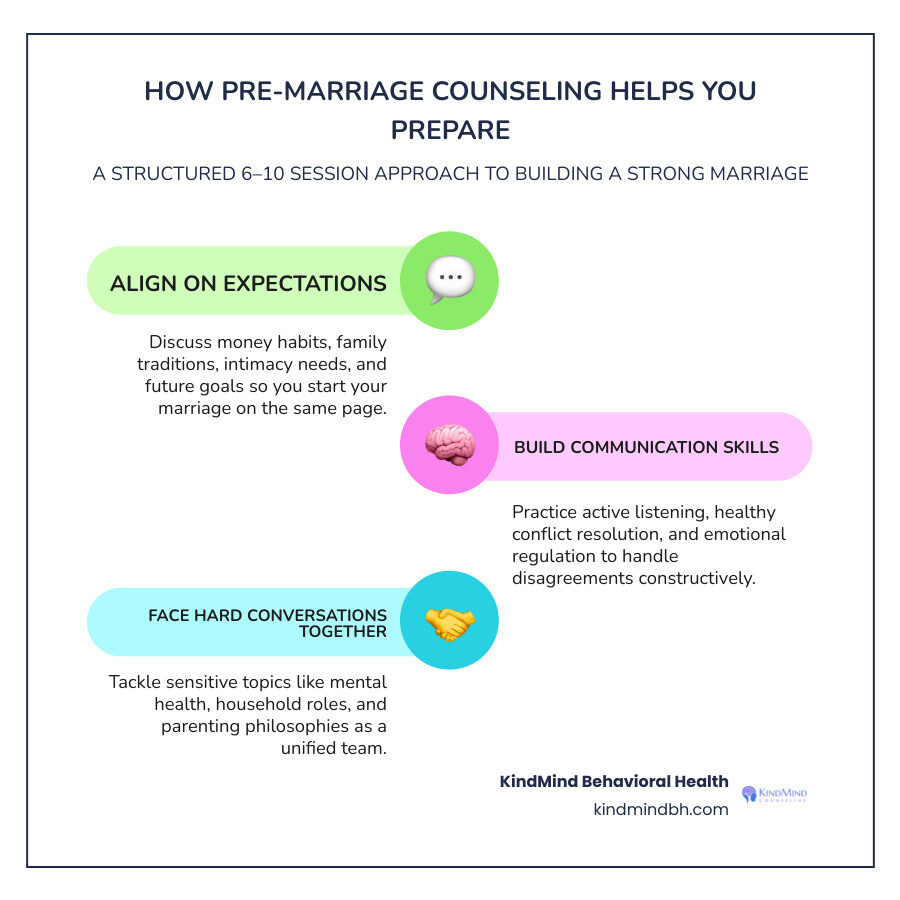
Pre-marriage counseling helps couples prepare for life together, not just the wedding. In a typical series of six to ten sessions, you can talk through expectations about money, family, intimacy, and future plans. You also practice ways to communicate and handle conflict. You do not need to be having problems to benefit.
The goal is not to agree on everything. It is to understand each other better and face hard conversations as a team. If you are considering support, KindMind Behavioral Health accepts most major commercial and non-commercial insurance plans. Check your plan’s coverage for couples sessions before booking.
Pre marriage counseling terminology:
Understanding Pre Marriage Counseling and Its Core Goals
Planning a wedding is thrilling, but it often consumes all our energy with seating charts, flower arrangements, and catering menus. Amid that whirlwind, it is easy to focus entirely on the wedding day while overlooking the lifetime of days that follow. That is where proactive preparation steps in. Our comprehensive Guide to Pre-Marriage Counseling highlights how taking intentional time before saying “I do” allows partners to build a resilient emotional foundation.
The primary goal of premarital preparation is not to test whether you should get married or force you and your partner into identical viewpoints. Instead, it provides a safe, guided space to explore marital expectations, fine-tune conflict resolution, and strengthen your emotional bond. By examining how you both navigate stress, celebrate successes, and make daily decisions, counseling helps you create a shared roadmap for long-term relationship health.
| Feature | Premarital Counseling | Standard Marriage Counseling |
|---|---|---|
| Primary Focus | Proactive foundation-building and prevention | Addressing existing conflicts or relationship distress |
| Timing | Prior to marriage or early commitment stages | Any point during marriage, often during crises |
| Typical Duration | Short-term (usually 6 to 10 structured sessions) | Variable (short-term or ongoing, depending on needs) |
| Core Themes | Values alignment, expectations, future goal setting | De-escalating distress, rebuilding trust, problem solving |
Premarital Counseling vs. Marriage Counseling: Key Distinctions
While both formats utilize evidence-based relational strategies, their starting points and trajectories differ significantly. Premarital counseling functions primarily as preventive care. It addresses topics before they turn into entrenched, painful arguments.
Standard couples therapy or marriage counseling often serves as an intervention. Couples frequently seek it after years of distress, unresolved resentment, or specific challenges like infidelity. Understanding the clinical dynamics of couples counseling helps normalize therapy as an ongoing tool rather than an emergency measure. Working through evidence-based couples therapy methods before patterns become rigid gives couples a distinct advantage in weathering future storms.
Why Strong Relationships Benefit from Pre Marriage Counseling
A common misconception is that seeking therapy means something is broken. In reality, couples who feel deeply connected often gain the most from premarital sessions. When you are not actively navigating a crisis, your nervous system is calm, making it much easier to absorb new communication tools and practice vulnerability.
Using attachment-based approaches, therapists help partners identify their emotional styles, such as how each person reacts when feeling overwhelmed, distant, or misunderstood. Discovering these tendencies early creates lasting emotional security, ensuring that everyday life reinforces rather than erodes your connection.
Research-Backed Benefits of Preparing Before the Wedding
Decades of relationship science highlight the positive impact of structured premarital preparation:
- Significantly Lower Risk of Divorce: Research indicates that divorce rates hover around 40% to 50% for first marriages and roughly 60% for second marriages. Engaging in premarital counseling has been shown to reduce divorce risk substantially.
- Measurable Relationship Advantage: Empirical studies show that couples who participate in premarital counseling fare better in relationship satisfaction and stability than 80% of couples who do not participate.
- Protection Against Mental Health Strain: Chronic marital distress is closely linked to higher rates of depression and anxiety. Proactive counseling stabilizes relational dynamics, creating a buffer against psychological distress.
- Long-Term Marital Protection: Research on relationship longevity shows that the divorce rate among adults aged 50 and older nearly doubled between 1990 and 2015, a shift often referred to as “Grey Divorce.” Proactively addressing underlying communication hurdles early helps protect marriages across every decade.
- Enhanced Connection and Community: Organizations like community marriage resources emphasize how guided relationship education supports stronger family units and generational well-being.

Essential Topics and Questions Explored in Sessions
Premarital therapy covers both everyday logistics and deep emotional principles. Sessions create a collaborative space where no topic is off-limits.
Key focus areas include:
- Financial Alignment: Discussing debt, spending habits, saving goals, joint versus separate accounts, and long-term financial philosophy.
- Family of Origin: Exploring the relational blueprints you grew up with, holiday expectations, boundary setting with in-laws, and which childhood traditions you want to carry forward or leave behind.
- Roles and Labor: Unpacking the daily division of household tasks and managing the mental load to avoid burnout.
- Parenting Philosophies: Clarifying whether you want children, timelines, discipline approaches, and schooling philosophies.
- Spirituality and Values: Integrating personal worldviews, whether through secular values or faith-based couples counseling principles.
- Physical and Emotional Intimacy: Talking openly about affection, physical desires, frequency expectations, and emotional closeness.
Navigating Mental Health, Stress, and Role Expectations
Life does not pause during wedding planning or after the ceremony. Stress, career changes, and personal health challenges will inevitably arise. Part of a solid premarital foundation involves learning about supporting a partner with mental health struggles while maintaining healthy boundaries.
At KindMind Behavioral Health, we believe that true relational wellness often requires a holistic view of care. Alongside couples therapy, individual mental health support and psychiatric services can play a transformative role. When an underlying condition such as clinical anxiety, depression, or mood dysregulation affects a partner’s daily functioning, integrating psychiatric evaluation and professional mental health medication management helps reduce individual suffering, which in turn nurtures the partnership. Our psychiatric providers collaborate closely with therapy goals to ensure you both have the emotional bandwidth to thrive.
25 Essential Questions for Engaged Couples

To jumpstart productive conversations at home or in sessions, explore these 25 essential questions together:
- Why do you choose me as your life partner, and what does marriage mean to you?
- How do you envision our daily life looking five or ten years from now?
- Are you naturally a saver or a spender, and what are your personal financial fears?
- Do we plan to combine our bank accounts, maintain separate funds, or use a hybrid model?
- How much debt do each of us carry, and what is our plan to manage or pay it off?
- How did your family handle conflict when you were growing up: yelling, silence, or open discussion?
- What boundaries do we want to establish with our parents and in-laws regarding visits and advice?
- How will we split holiday time and family traditions fairly?
- What values or rituals from your childhood do you want to continue in our home?
- Do you want to have children, and if so, how many and on what timeline?
- What would we do if we faced fertility challenges or unexpected family planning hurdles?
- What are your expectations regarding childcare, discipline, and schooling?
- How do you prefer to receive affection and emotional reassurance during hard times?
- Are you comfortable discussing our physical intimacy, desires, and changes in drive over time?
- How will we ensure we still prioritize regular date nights and one-on-one connection?
- How will we divide household chores, meal prep, and administrative mental load?
- What are your long-term career ambitions, and how will we balance moves or promotions?
- How important are individual hobbies, solo time, and friendships outside our marriage?
- Does either of us have spiritual or religious practices, and how will they shape our home?
- What is your process for making major life decisions, such as buying a house or changing careers?
- What happens when one of us feels overwhelmed, burned out, or emotionally withdrawn?
- How will we recognize if our relationship needs professional therapy support in the future?
- What are your views on personal privacy versus transparency regarding phones and social media?
- What are your absolute non-negotiables or boundaries regarding trust and fidelity?
- What are three strengths you believe our partnership possesses that will help us navigate future hardships?
The Counseling Process: What to Expect and How to Prepare
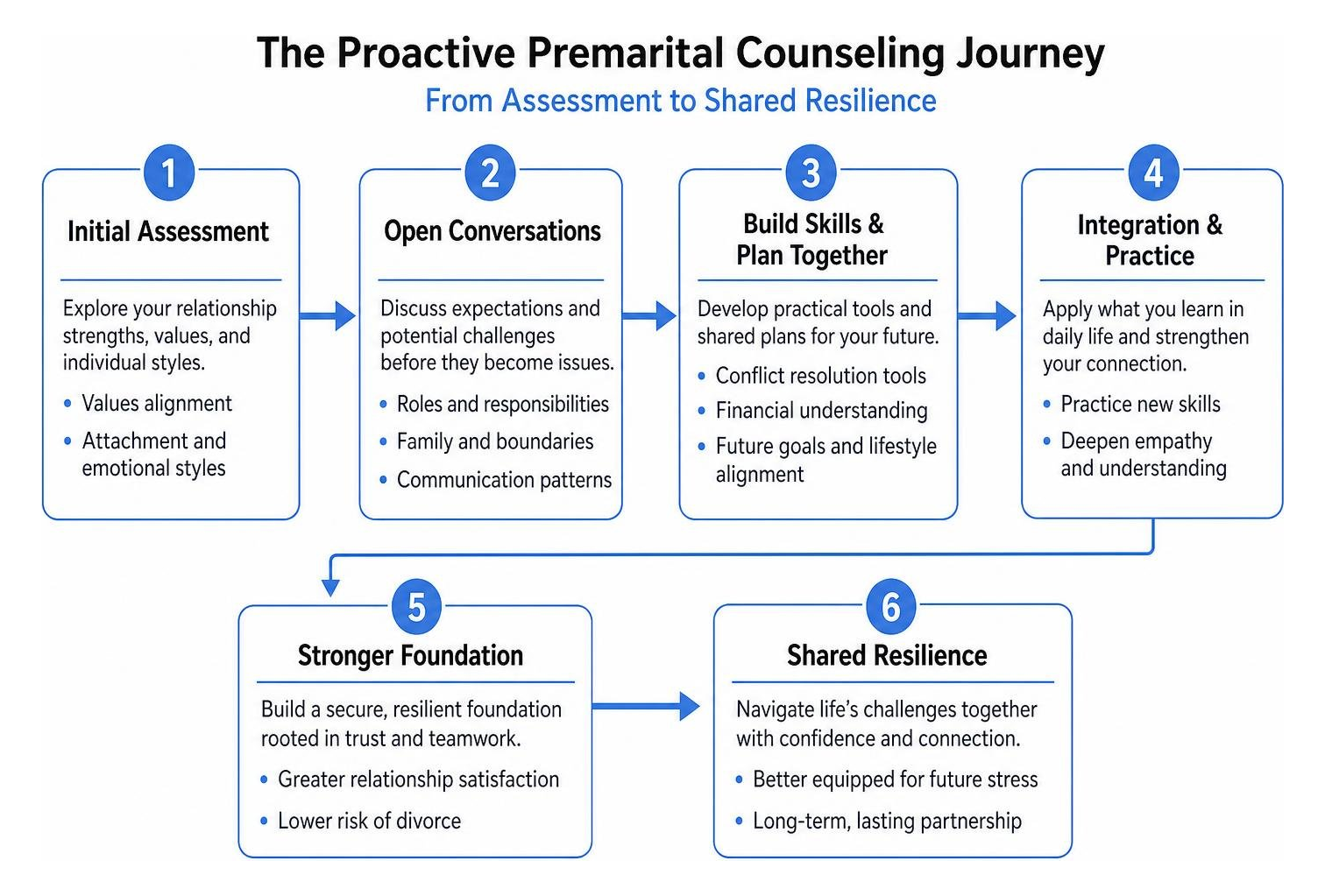
Premarital counseling is a structured, collaborative experience. It typically begins with an initial intake session where your clinician learns about your relationship history, unique backgrounds, and specific goals. From there, you will move through thematic discussions, communication role-playing, and exercises designed to build somatic awareness, helping you notice physical cues like tightness in the chest or jaw during difficult conversations.
Our comprehensive couples and family therapy services provide a calm, structured space tailored to your unique dynamic. Sessions often include light homework, such as practicing active listening techniques or trying a weekly check-in routine. If you have questions about logistics, our overview on demystifying couples counseling costs can help you plan your schedule and budget with confidence.
Finding the Right Therapist for Pre Marriage Counseling
Finding a clinician who makes both partners feel heard and respected is essential. Look for licensed clinicians, such as Licensed Marriage and Family Therapists (LMFTs), Licensed Professional Counselors (LPCs), or Clinical Social Workers, who have specialized training in modalities like the Gottman Method or the Psychobiological Approach to Couples Therapy (PACT).
Guidance on finding the right fit with a therapist and strategies on how to find a therapist for in-person care near your home can help you choose a provider who matches your goals, communication styles, and cultural values.
What to Do If Your Partner Is Hesitant
It is completely normal for one partner to feel hesitant about counseling. Common concerns include fears of being blamed, having past mistakes brought up, or feeling forced into an uncomfortable environment.
To help ease this apprehension:
- Frame it as an investment, not a repair: Emphasize that counseling is about setting the relationship up for success, similar to taking a class or working with a coach.
- Clarify the therapist’s role: Remind your partner that a skilled clinician acts as an unbiased guide, never a judge or referee taking sides.
- Start with a consultation: Suggest a brief, low-pressure introductory call so both of you can ask questions and get comfortable with the process before committing.
Frequently Asked Questions About Premarital Preparation
How many sessions does premarital counseling usually require?
Most couples complete premarital counseling in six to ten sessions, though some choose a slightly broader series of 12 sessions depending on their goals. Sessions are usually scheduled once a week or every other week, making it easy to fit into your calendar during wedding planning.
Does seeking premarital therapy mean our relationship has problems?
Not at all. In fact, seeking premarital therapy is a sign of relationship strength and proactive maturity. Just as you invest in regular physical checkups or retirement planning, premarital counseling is a positive investment in your emotional future.
Can premarital counseling be conducted online or through telehealth?
Yes. Virtual counseling has become exceptionally popular for busy couples juggling work, wedding logistics, and family commitments. Telehealth allows partners to log in from the comfort of their home or even join from different locations during busy workdays while receiving the exact same evidence-based support as in-person care.
Conclusion
Preparing for marriage is one of the most exciting journeys of your life. While wedding celebrations last for a single day, the communication habits, emotional safety, and shared resilience you build today will sustain your partnership for decades. Investing in your relationship before stepping into marriage gives you both the clarity, empathy, and tools needed to navigate whatever the future holds.
At KindMind Behavioral Health, we are dedicated to helping couples and individuals across Michigan build grounded, fulfilling lives. Whether you prefer in-person appointments at our offices in Rochester, Clarkston, Detroit, or throughout Oakland County, or the flexibility of secure telehealth across the state, our integrated team offers comprehensive therapy and psychiatry services tailored to your needs.
We accept most major commercial and non-commercial insurance plans, including Aetna, ASR, Blue Care Network, Blue Cross Blue Shield, Blue Cross Complete, Cigna, Cofinity/Varipro, Health Alliance Plan (HAP), Humana, McLaren, Medicaid, Medicare, Meridian, Meritain, Priority Health, TRICARE East, and UnitedHealthcare/Optum.
Take the next step in preparing for a lifetime of partnership. We invite you to book an appointment or consultation for KindMind Behavioral Health couples therapy services today.
The information in this article is for educational purposes only and is not intended as medical or mental health advice. Individuals should consult a licensed healthcare professional regarding their specific health needs.