

Answering Tricky Drug Information Questions Without Second-Guessing
Answering Tricky Drug Information Questions Without Second-Guessing
A Step-by-Step Approach to Resolving Drug Information Questions
Resolving drug information questions starts with a structured clinical workflow: gather comprehensive patient background, classify the request, search the evidence hierarchy from tertiary to primary sources, and critically synthesize a recommendation. This method prevents oversights when healthcare providers or individuals encounter unfamiliar symptoms, unexpected side effects, or complex regimens. Following established guidelines on the systematic approach to answering drug information requests ensures that every response is evidence-based, clinically sound, and tailored to the person’s unique health profile.
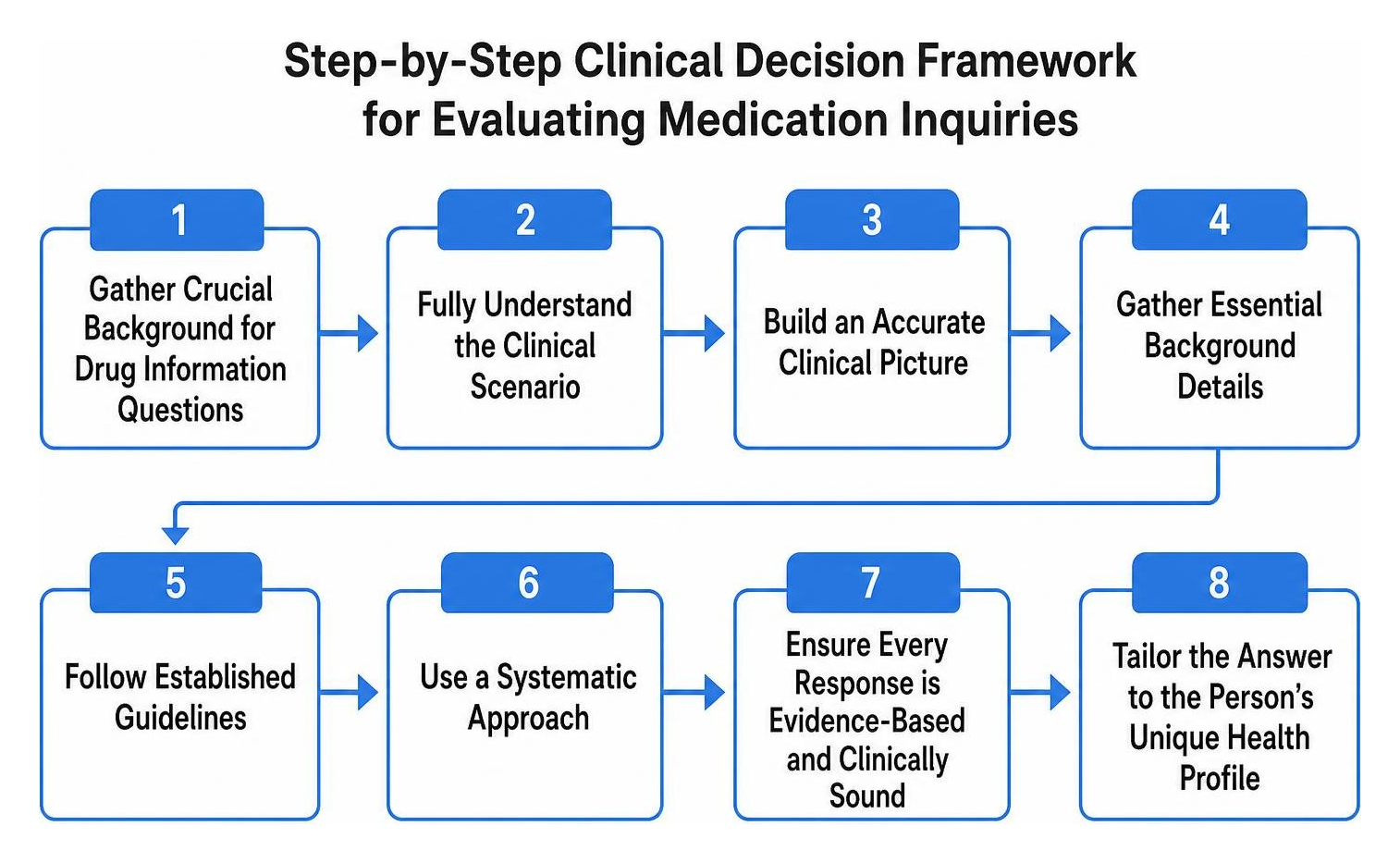
Step 1: Gathering Crucial Background for Drug Information Questions
Before looking up answers in reference databases, you must fully understand the clinical scenario. An inquiry that seems straightforward on the surface, such as asking whether a medication causes headaches, often depends entirely on individual health factors.
To build an accurate clinical picture, gather essential background details:
- Patient Demographics: Age, biological sex, pregnancy or lactation status, height, and current body weight.
- Organ Function and Labs: Baseline renal clearance, estimated glomerular filtration rate, and liver function panels.
- Complete Medication Profile: All current prescription drugs, over-the-counter remedies, vitamins, herbal supplements, and recent medication changes or discontinuations.
- Clinical Context and Timeline: The exact timeline of when symptoms began relative to starting or adjusting a dose, the specific medical conditions being treated, and whether the issue is acute or chronic.
- Requestor Context: Clarify why the question is being asked, what has already been tried, and the expected timeframe for a response.
Step 2: Classifying and Formulating the Search Strategy
Once the background is clear, classify the request into a specific category. This helps focus your research and points you toward the right medical literature.
Common classifications include:
- Adverse drug reactions and safety profiles
- Dosing, administration routes, and titration schedules
- Drug-drug, drug-food, or drug-supplement interactions
- Pharmacokinetic parameters (absorption, distribution, metabolism, and elimination)
- Special population safety (pregnancy, lactation, pediatrics, or geriatrics)
- Product availability, foreign drug equivalents, or therapeutic substitutions
When searching medical compendia, always use standard generic names rather than brand names. Generic nomenclature remains consistent across clinical databases and global health resources, whereas brand names vary widely by manufacturer and region.
Step 3: Evaluating Evidence and Delivering the Response
Gathering data is only half the battle; the findings must be critically appraised before formulating a recommendation. Consider study designs, sample sizes, publication dates, and whether the findings directly apply to the specific individual.
When delivering the final response:
- Synthesize the Findings: Combine information from multiple credible sources rather than relying on a single reference.
- Highlight Practical Relevance: Clearly explain how the evidence applies to the specific situation, noting any limitations in the available literature.
- Choose the Right Communication Method: Provide clear verbal counseling or structured written documentation based on the person’s needs.
- Establish Follow-Up Steps: Outline specific signs of improvement or potential warning symptoms that warrant immediate clinical attention.
Reliable Evidence Sources and Literature Search Hierarchy
Finding trustworthy answers requires knowing where to look. In healthcare, medical literature is organized into a three-tiered hierarchy. Understanding how to navigate these tiers allows clinicians to retrieve accurate information quickly, following standard evidence-based drug information basics.
Navigating Tertiary, Secondary, and Primary Resources
The standard literature search hierarchy moves from synthesized tertiary resources down to specialized primary studies when deeper investigation is needed.
| Literature Tier | Description & Common Examples | Key Strengths | Limitations | Best Use Cases |
|---|---|---|---|---|
| Tertiary | Point-of-care compendia, textbooks, and curated clinical monographs (e.g., Lexicomp, Micromedex, standard pharmacology reference manuals) | Fast, concise, expert-reviewed, and easy to interpret at the bedside | Can lag behind emerging clinical research by several months or years | Initial lookups for dosing, approved indications, contraindications, and known adverse effects |
| Secondary | Indexing and abstracting search systems (e.g., PubMed, MEDLINE, Embase, Cochrane Library) | Broad indexing that quickly directs clinicians to relevant peer-reviewed studies | Requires specialized search skills and critical appraisal of indexed results | Locating recent clinical trials, systematic reviews, and meta-analyses on complex topics |
| Primary | Original research articles, published clinical trials, observational cohort studies, and case reports | Most up-to-date evidence available; provides full methodologies and raw data | Time-intensive to evaluate; individual studies may have narrow clinical scope or bias | Investigating novel off-label therapies, rare adverse events, or unapproved drug combinations |
Free Online Portals and Reference Databases
When subscription-based clinical compendia are unavailable, several authoritative, open-access resources provide high-quality data:
- DailyMed: Maintained by the National Library of Medicine, DailyMed hosts official, FDA-approved package inserts and drug labeling.
- LactMed (Drugs and Lactation Database): A specialized, peer-reviewed database detailing maternal and infant drug levels during breastfeeding.
- FDA MedWatch and Safety Alerts: Real-time alerts regarding safety advisories, boxed warnings, and post-market drug safety updates.
- Poison and Toxicology Services: Local resources such as regional toxicology and drug information support provide 24/7 expert guidance for acute exposures, overdoses, and toxic ingestions.
Common Categories of Clinical Medication Inquiries
Clinical medication inquiries span a wide range of topics, from simple administration guidelines to intricate pharmacotherapy decisions.
Triaging Complex Psychiatric and Specialty Drug Information Questions
In psychiatric care, medication management requires a careful, highly individualized approach. Learning about the psychiatric medication options and risks is an essential step when tailoring care to each person’s unique biology and treatment history.
Psychiatric inquiries often involve:
- Titration and Tapering Protocols: Gradually adjusting doses to minimize adverse effects or safely discontinuing a medication to prevent discontinuation symptoms.
- Off-Label Indications: Reviewing emerging clinical data for treatments used outside standard approvals.
- Ongoing Monitoring: Understanding what your provider monitors during medication management, such as metabolic panels, therapeutic blood levels, vital signs, and overall symptom response.

Adverse Effects, Contraindications, and Interaction Screening
Ensuring medication safety requires screening for interactions and distinguishing between common side effects and true allergic responses.
Key safety areas include:
- Cytochrome P450 (CYP450) Pathways: Identifying enzymatic induction or inhibition that could alter blood concentrations of co-administered drugs. We explore these concepts in our guide on understanding drug interactions.
- Boxed Warnings and Contraindications: Reviewing major safety warnings, such as risks associated with combining central nervous system depressants or pregnancy-related contraindications.
- Adverse Effect Differentiation: Separating standard medication side effects (such as mild, transient nausea) from severe, urgent adverse events (such as rash, severe swelling, or signs of serotonin toxicity).
The Value of Dedicated Drug Information Services for Patient Safety
Drug information services and clinical medication reviews play a vital role in preventing harm, improving treatment outcomes, and lowering unnecessary medical expenses. Practicing safe medication management helps protect individuals at every stage of their treatment journey.
Reducing Healthcare Costs and Preventable Adverse Events
Research consistently demonstrates that dedicated drug information consulting leads to measurable improvements in clinical care and cost efficiency:
- Up to 50% of all prescriptions fail to produce their intended benefits due to improper use, administration errors, or unmanaged side effects.
- Preventable medicine-related illnesses account for over $75 billion annually in unnecessary doctor visits, extra prescriptions, hospital stays, and lost workplace productivity.
- Adverse drug reactions remain a critical public health concern, estimated as the 4th to 6th leading cause of death in the United States.
- In inpatient settings, dedicated drug information services are associated with cost savings of approximately $1,962 per occupied bed per year, equating to $430,580 to $1.7 million in annual hospital savings through reduced medication errors, shorter stays, and lower patient mortality rates.
- Direct clinical consultations prevent costly diagnostic missteps. In one documented clinical scenario, consulting a drug information specialist about neuroleptic-induced prolactin elevation saved $2,573 by avoiding an unnecessary brain CT scan. In a similar case where no specialist was consulted, avoidable diagnostics and treatments accumulated $42,892 in unnecessary expenses.
Essential Questions Patients Should Ask About Prescriptions
Active communication between individuals and their healthcare team is one of the most effective ways to prevent medication errors. The AHRQ guide to essential questions for healthcare providers highlights practical questions to ask whenever a new medication is prescribed:
- What are the exact brand and generic names of this medication?
- What is this medication supposed to do, and when should I expect it to start working?
- How many times per day should I take it, and should it be taken with food or on an empty stomach?
- What should I do if I accidentally miss a dose?
- What common side effects might occur, and which symptoms require an immediate call to the clinic?
- Does this medication interact with my existing prescriptions, over-the-counter products, or dietary supplements?
- Are there specific foods, beverages, or activities (such as driving) that I should avoid while taking this?
- How long will I need to stay on this medication, and how will we know if it is helping?
- How should this medication be stored safely at home?
- Can this prescription be refilled, and will it require routine lab work or follow-up appointments?
Frequently Asked Questions About Medication Inquiries
What is the recommended hierarchy for searching clinical drug information?
The standard search workflow starts with tertiary resources (such as curated drug compendia and clinical monographs) for quick, peer-reviewed answers. If the information is incomplete, clinicians turn to secondary indexing databases (such as PubMed or MEDLINE) to find recent systematic reviews, clinical trials, or primary literature.
What critical background must be verified before answering a dosing question?
Before confirming an appropriate dose, a healthcare professional must review the person’s age, body weight, kidney and liver function lab values, current medication list, existing medical conditions, and pregnancy or lactation status.
How do drug information services directly reduce healthcare expenses?
Drug information services lower healthcare expenses by preventing adverse drug interactions, avoiding inappropriate polypharmacy, eliminating redundant or unnecessary diagnostic testing, and reducing hospital readmissions.
Conclusion
Navigating complex medication decisions requires clear evidence, clinical experience, and open communication. When you or a loved one have questions about a psychiatric medication, you do not have to figure it out alone.
At KindMind Behavioral Health, we provide compassionate, patient-centered mental health care across Michigan, serving communities throughout Rochester, Clarkston, Detroit, and Oakland County. Our team offers integrated support, combining individualized psychotherapy with comprehensive psychiatric medication management services to ensure your care plan is safe, effective, and tailored to your goals.
We provide both in-person appointments and flexible virtual telehealth visits across Michigan, making high-quality psychiatric care accessible wherever you are. To help keep care accessible, we accept most major commercial and non-commercial insurance plans, including Aetna, ASR, Blue Care Network, Blue Cross Blue Shield, Blue Cross Complete, Cigna, Cofinity/Varipro, Health Alliance Plan (HAP), Humana, McLaren, Medicaid, Medicare, Meridian, Meritain, Priority Health, TRICARE East, and UnitedHealthcare/Optum.
If you have questions about your current mental health treatment or want to explore starting care, we are here to help. Book an appointment or consultation with KindMind Behavioral Health today to take the next step in your wellness journey.
The information in this article is for educational purposes only and is not intended as medical or mental health advice. Individuals should consult a licensed healthcare professional regarding their specific health needs.